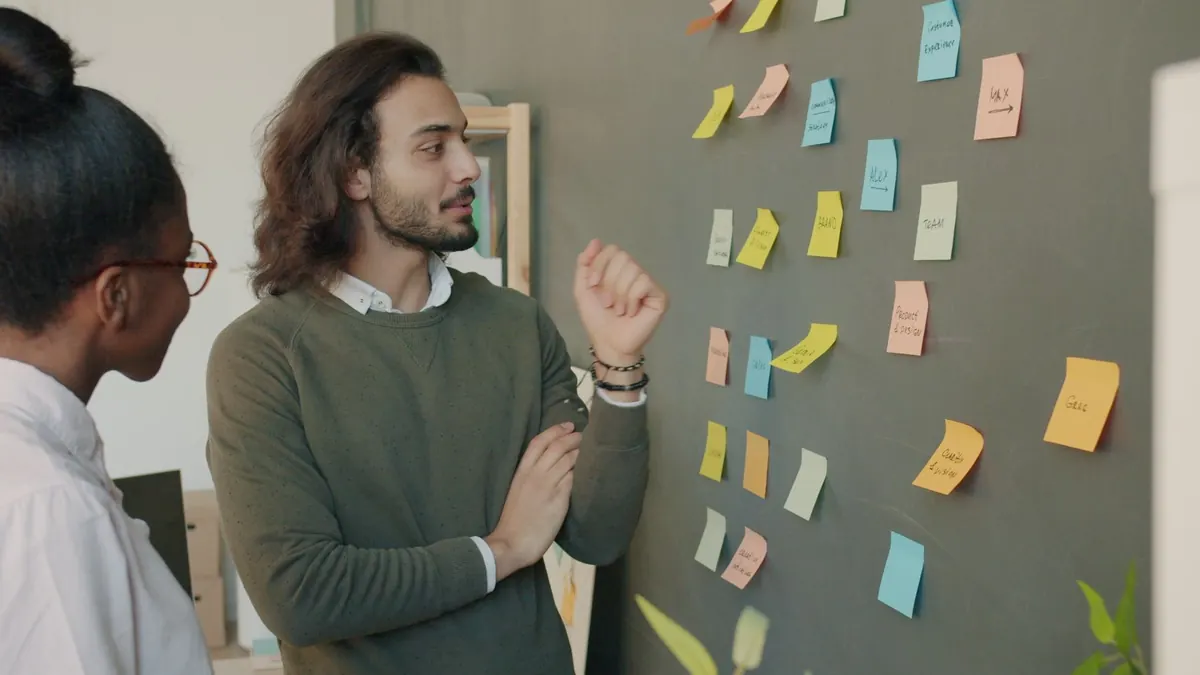
A one-day brand workshop with a small team is not a brainstorm. It is a set of decisions with a clock running. Six people, one room, a wall you are allowed to tape things to — that is enough to come out with positioning, a voice, and a visual direction you can actually use. The trick is sequencing: gather evidence before you argue, argue before you decide, and decide before everyone gets tired. Here is an agenda that fits into a single working day without a facilitator who owns a whistle.
Before the day: the only prep that matters
Name the decision. Write one sentence and pin it above the whiteboard: By 4pm we will have agreed on our positioning, our voice, and three visual principles. Vague intentions produce vague afternoons.
Keep the group to six or seven people. Include someone who talks to customers every week and someone who makes things — a designer, a writer, a developer. Anyone who can veto the outcome but will not attend should be briefed beforehand, not surprised afterwards.
Three to five days ahead, collect raw material: twenty to thirty lines of customer language pulled from emails, calls, reviews and support tickets. Verbatim, not summarised. Ask each attendee to bring one competitor they admire and one they do not, plus a single sentence explaining why.
For the room: a wall, painter's tape, sticky notes, markers, a whiteboard. Laptops closed except for the note-taker. Phones in a basket by the door. It sounds fussy. It works.
The agenda at a glance
- 9:00 — Framing and the one decision (20 min)
- 9:20 — Evidence dump (40 min)
- 10:00 — Positioning: two axes (75 min)
- 11:15 — Break
- 11:30 — Positioning: the statement (45 min)
- 12:15 — Lunch, off-topic, no shop talk (45 min)
- 1:00 — Voice: say this, not that (60 min)
- 2:00 — Visual direction: reference walls (60 min)
- 3:00 — Pressure-test what you have (30 min)
- 3:30 — Decisions, owners, dates (30 min)
- 4:00 — Done, with twenty minutes of slack built in
Morning: finding a position you can defend
Exercise 1 — The customer's words
Spread every collected quote across the table or tape them to the wall. For the first ten minutes, nobody speaks. Everyone sorts silently into themes, moving notes they disagree with. Then talk. Name the three themes that keep appearing. These become your language for the rest of the day, and later, for your website copy.
Exercise 2 — Two axes
Draw a large cross on the wall. Choose two axes that matter to buyers and that you can realistically win. Avoid "quality versus price" — every company claims quality. Try hands-on versus hands-off, specialist versus generalist, fast versus considered, for beginners versus for professionals.
Place every competitor you can name, then place yourselves. Then ask the uncomfortable question: which square is empty, and do we honestly belong in it?
Exercise 3 — The positioning statement
Fill in the blanks: We are the ___ for ___ who ___, and unlike ___, we ___. Write five versions quickly, talking over each other if you have to. Then cut to one. If a clause cannot be backed by evidence from the morning, delete the clause. Boring and true beats clever and vague every single time.
Afternoon: voice and visual direction
Voice: say this, not that
Write three pairs of sentences. On the left, the line a generic brand would publish. On the right, yours. For example: "We provide comprehensive solutions" becomes "We fix the thing that's broken before Friday." Three pairs give a writer enough direction to draft a homepage. Then agree on three words you will ban from your own copy — solutions, seamless and innovative are common casualties.
Visual direction: reference walls
Print the references people brought. Eight to ten each is plenty. Group them by feeling rather than by category — not "websites" and "packaging", but "calm" and "blunt". Name each group with three adjectives.
Then agree on principles instead of assets. Photography is close and unposed. Type stays quiet. Colour does the shouting. Whitespace is generous. Naming what to avoid is usually more useful than naming what to include, because it prevents the same argument returning in a month.
Close with a gut check: everyone picks the single reference that feels most like you and explains why in one sentence. Where people agree, you have a direction. Where they do not, you have found next week's conversation.
Where the day usually goes wrong
- Skipping the evidence. Without customer language, opinions rush in and the loudest voice wins.
- Trying to finish the logo. Visual identity is downstream of direction. Sketching marks before lunch wastes the morning.
- No decision-maker in the room. If nobody can say "yes, that is it", you leave with options instead of a decision.
- Open-ended discussion. Set a timer for every exercise. The constraint is the point; it forces people to choose.
- No owners. Every output needs a name and a date attached, or the day evaporates by Wednesday.
The 48 hours after
Before anyone leaves, the note-taker photographs the wall. That evening or first thing the next morning, they type a one-page brand spine: the positioning statement, three voice pairs, three visual principles, three things to avoid, and a short list of next steps with owners. One page. If it runs to four, nobody will read it.
Send it to everyone the following day, including the person who could not attend, and ask for corrections within twenty-four hours — corrections, not new opinions. There is a difference, and stating it out loud saves a week.
Then book the review before the week ends. Direction is not a document; it is a set of decisions applied. The real test is simple: can a writer draft a homepage and a designer sketch two directions that both feel unmistakably like the same brand? If yes, the day worked. If not, you now know exactly which clause needs revisiting, and you have the wall photos to show why you chose it in the first place.
Run it twice a year. Brands drift, teams change, customers find new words for what they want. One day, six people, and a wall is a small price for staying on course.
Photo: Vitaly Gariev / Pexels